

We may receive a commission on purchases made from links.
Thanks to the success of “Star Wars” in 1977, science fiction became the dominant trend in Hollywood for the then-foreseeable future. Prior to 1977, high-end, big-budget sci-fi movies were rare, usually coming along only a few times a decade. After “Star Wars,” everyone and their mother tried to replicate that film’s success, often succeeding. Sci-fi, fantasy, and effects-based movies were going to dominate the box office for years. The 1980s kicked things off with a successful “Star Wars” sequel, “The Empire Strikes Back” (which was, coincidentally, the first film Harrison Ford was happy with). 1981’s biggest hit was “Superman II.” 1982 saw major hits with Steven Spielberg’s “E.T. the Extra-Terrestrial” and “Star Trek II: The Wrath of Khan.” In 1983, “Star Wars” returned again with “Return of the Jedi.” In 1984, it was “Star Trek III: The Search for Spock” and “Ghostbusters.” 1985 featured “Back to the Future” and “Cocoon.” 1986 saw “Aliens” and “Star Trek IV: The Voyage Home.” And so on.
Because sci-fi was viable as a commercial effort, the genre continued to proliferate in small-budget circles as well. For every “Star Wars,” there were 1,000 B-movies hitting the straight-to-video market, trying to bank on the genre’s success. The proliferation of sci-fi in the mainstream allowed more daring artists to indulge in their sci-fi interests. Genre magazines had been huge in the fan community for decades, and the 1980s allowed sci-fi to spread like wildfire on TV and in grindhouse cinemas. Sure, not all the B-movies were ambitious or intellectual, but they called for a level of filmmaking resourcefulness and excitement that genre fans definitely appreciated.
Below are only five of the lesser-known but higher-quality sci-fi efforts to come from the 1980s, presented chronologically.
Turkey Shoot (1982)
If you don’t yet know about the output of Australian director Brian Trenchard-Smith, your film education is not complete. Trenchard-Smith was one of the many filmmakers who rose to prominence in the mid-1970s during a boom in Australian exploitation movies. Aussie censorship laws had changed a few years earlier, allowing a new influx of sex and violence into the country’s cinemas, and Australian filmmakers seemed to have an innate understanding of how exploitation movies were supposed to look. Trenchard-Smith was at the forefront with films like “The Man from Hong Kong,” “Deathchasers,” and the amazingly weird musical/biobpic “Stunt Rock.” He also did “Leprechaun 4: In Space,” which placed higher than expected on our “Leprechaun” movie ranking.
Trenchard-Smith’s true calling card came in 1982 with “Turkey Shoot,” a bizarre dystopia prison movie set in the distant future of 1995. The 1980s moral police have taken over the world, and so-called “deviants” are sent to prison camps for “reeducation.” There’s a healthy rebellion at work, but many of their operatives end up in prison camps — torture farms where inmates are hunted for sport. Steve Railsback plays an innocent shopkeeper who’s unjustly imprisoned and has to survive his human hunt with a fellow innocent (Olivia Hussey).
“Turkey Shoot” is wildly violent, and definitely fun. It’s also a little surreal. One can easily picture the bleak dystopia the film describes, but why is there a werewolf in the film as well? The prison warden seem to have a genetically engineered beast-man in their employ. It’s also clearly a criticism of Reagan’s dumb vision for America in the 1980s, and a prod at Margaret Thatcher as well. Yet, rather unfortunately, it remains timely in 2026.
“Turkey Shoot” was released as “Escape 2000” in the United States, and as “Blood Camp Thatcher” in England.
Born in Flames (1983)
A lot of American media of the 1980s struggled with the rise of Reagan-inspired conservatism, leading to an underground explosion of punk rock, New Wave, and queer rebellion. Nowhere could this be more sharply felt than in Lizzie Borden’s 1983 classic “Born in Flames,” a futuristic drama about an altered media landscape, infighting among revolutionaries, and the insidious way conservative institutions undercut everything. /Film once said that it was one of five movies of the 1980s that captured the meaning of life.
In the world of “Born in Flames,” it has been 10 years since a successful socialist revolution, but the world is not content. Two rival radio stations, both of them run by angry lesbian collectives, are butting heads over what the progressive message should be. Despite the revolution, sexism remains prevalent, and women are being attacked on the street by grumpy misogynists. A woman’s army rises to take matters into their own hands via vigilantism, while the two rival DJs — Honey (Honey) and Isabel (Adele Bertei) — try to think of nonviolent solutions.
Meanwhile, the government itself has been re-infiltrated by an even more sexist, ultraconservative movement that is proposing that all women go back to being homemakers. The Reagan-like president is even proposing a salary for women who stay at home to clean house. The physical and social violence of “Born in Flames” is only abated when women put their differences aside and fight the real enemy: the systemic hatred of women.
“Born in Flames” is fueled by forthright, stirringly intellectual, and wholly righteous indignation. This is a film that points out how progressives can lose sight of the bigger picture because they’re too busy bickering the smaller details. But political movement can happen if we focus on the oppressive state as a unit. The film is angry, stirring, and exciting from beginning to end.
Eliminators (1986)
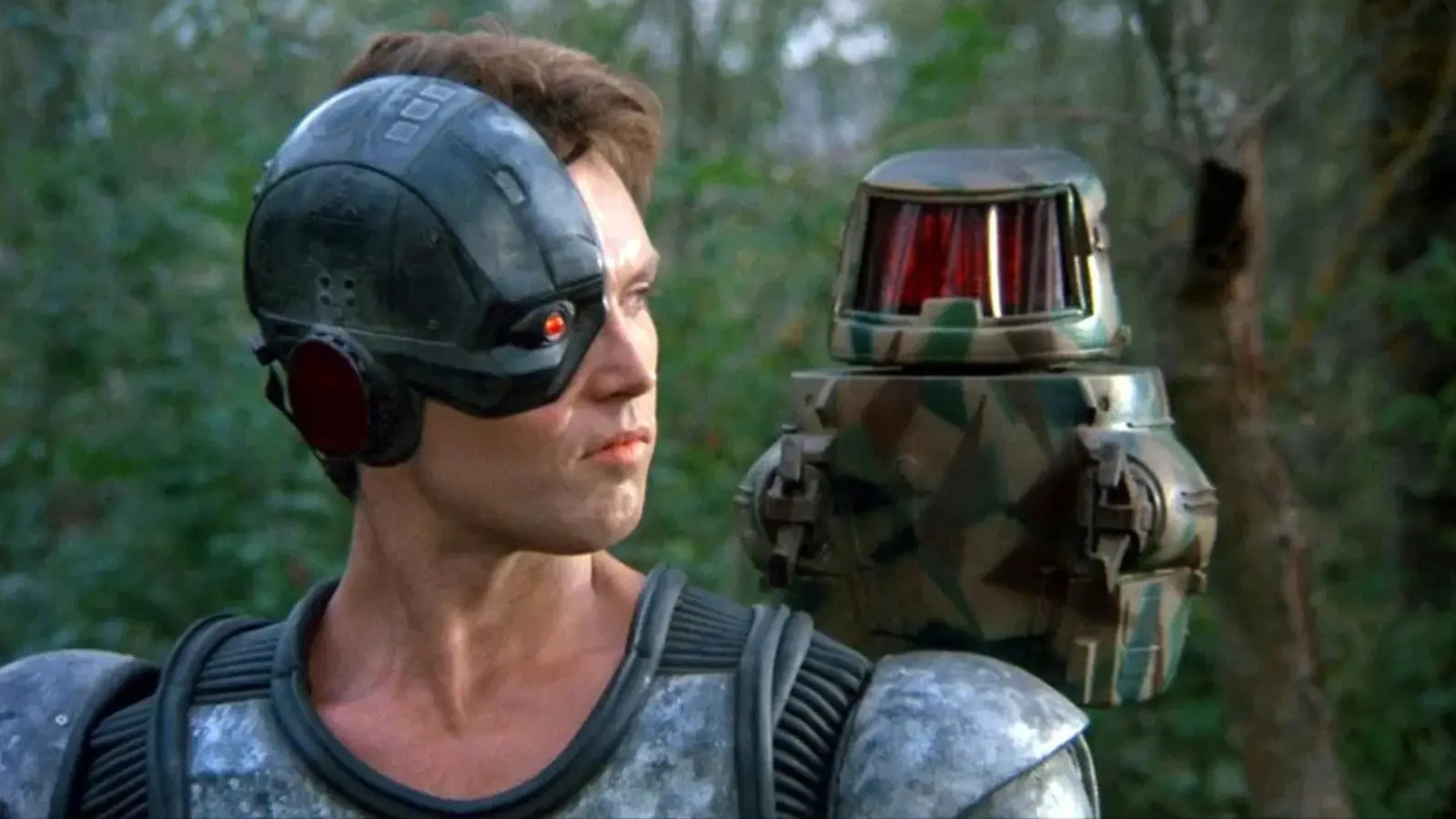
Peter Manoogian’s 1986 actioner “Eliminators” feels like a little kid making up a story while banging action figures together. It’s a low-budget, live-action Saturday morning cartoon, and that’s meant as a high compliment. “Eliminators” is about a ragtag group of adventurers who unite to stop an evil time-traveling mad scientist with dreams of conquering the world. The main character is a Mandroid named John (Patrick Reynolds) whose torso can be attached to either robotic legs or tank treads as the situation warrants. He’s sent back in time to find Colonel Hunter, a brilliant scientist who might know how to stop the evil Dr. Reeves (Roy Dotrice). Colonel Hunter was played by “Star Trek” actress Denise Crosby, who beat five other actresses to play the role of Tasha Yar in that series.
Together with a small, floating robot buddy named S.P.O.T., their quest leads them to a remote lab in the jungle. In order to traverse a river, they hire a smooth-talking Indiana Jones type named Harry Fontana (Andrew Prine) who spends the bulk of the film flirting with Colonel Hunter. Oh yes, and they also somewhat randomly accumulate Kuji (Conan Lee), a ninja who aims to take revenge on Dr. Reeves for killing his father. The action is low-rent but earnest, and the Mandroid effects are impressive for a film of its budget. “Eliminators” was produced by Charles Band, who produced “From Beyond,” “Rawhead Rex,” and “TerrorVision” that same year. It was a good time to be a weird kid into monster movies.
So here we have a movie about a Mandroid, a babe scientist, a floating robot, an irascible ship captain, and a ninja trying to stop an evil scientist from the future. If I haven’t sold you on “Eliminators,” I’m not sure what else could do it.
SpaceCamp (1986)
Harry Winer’s 1986 film “SpaceCamp” was a victim of bad timing. The film was about a space shuttle disaster, and it had the misfortune of opening only a few months after the Challenger disaster. It’s a pity, though, as “SpaceCamp” is a fun, marvelous adventure film for aspiring kids.
The title of “SpaceCamp” will be immediately evocative to kids of the 1980s, as a trip to a real-life, NASA-based SpaceCamp was a common grand prize from kid-friendly game shows of the era. Winer’s movie follows a group of five kids, aged 12 to 17, as they attend such a camp to enjoy a week of real-world astronaut training. The kids are played by Tate Donovan, Lea Thompson, Kelly Preston, Larry B. Scott, and Leaf Phoenix. While training in a shuttle, a cranky robot (voiced by Frank Welker) accidentally ignites a booster, causing the shuttle to start lifting off. To save the kids, NASA ignites all the boosters and launches the kids into space for real. The untrained teens then have to use their wits and resources to figure out a way to survive long enough to return to Earth.
“SpaceCamp” may be a desperate disaster film about teens running out of oxygen, but it’s also a wish-fulfillment fantasy of the highest order. Many kids have astronaut dreams, and “SpaceCamp” was a dream of how they could skip the decades of space flight training and go into orbit, ASAP. The kids were all quirky and flawed the way teens are, making the character appealing and believable. The musical score by John Williams also helps the film feel grand and adventurous.
The token adults are played by Kate Capshaw and Tom Skerritt. “SpaceCamp” was going to be remade for Disney+, but the plans fell through.
Communion (1989)
Back in 1985, author Whitley Streiber began having disturbing dreams, believing there were mysterious invaders in his home. While on vacation in a remote cabin with several friends, Streiber claims to have seen a strange, large-eyed being in his bedroom. In the months that followed, Streiber’s dreams became much more vivid, his visions haunted by lanky grey-skinned alien beings, as well as blue-skinned, newt-like gnomes. The visions put a strain on his marriage, and threatened to drive him crazy. Streiber underwent hypnotic therapy and found, through recovered memories, that he was being abducted by alien beings, which would perform medical and sexual experiments on him.
Streiber wrote about his experiences in the 1987 book “Communion: A True Story,” which became a huge hit and is largely responsible for the proliferation of alien lore throughout the 1980s and 1990. In 1989, Streiber adapted his book into a screenplay for filmmaker Philippe Mora, who turned Streiber’s experiences into an explicit and haunting feature film. /Film once described “Communion” as one of the weirdest alien movies you’ll ever watch. Christopher Walker played Streiber, and Lindsay Crouse played his wife, Anne. Streiber wanted the film to remain as pure to his experience as possible, so he insisted it be a smaller, independent picture; a studio would likely have added more salacious details and inappropriate special effects. That said, he agreed never to visit the set or give input while Mora was directing.
The result is a surprisingly intimate, adult drama about how alien abduction can rip one apart from the inside. It’s about a mystery that can never really be understood. It’s about how alien life is always going to be something our minds are not equipped to handle. It’s a pretty great film.
Source link
